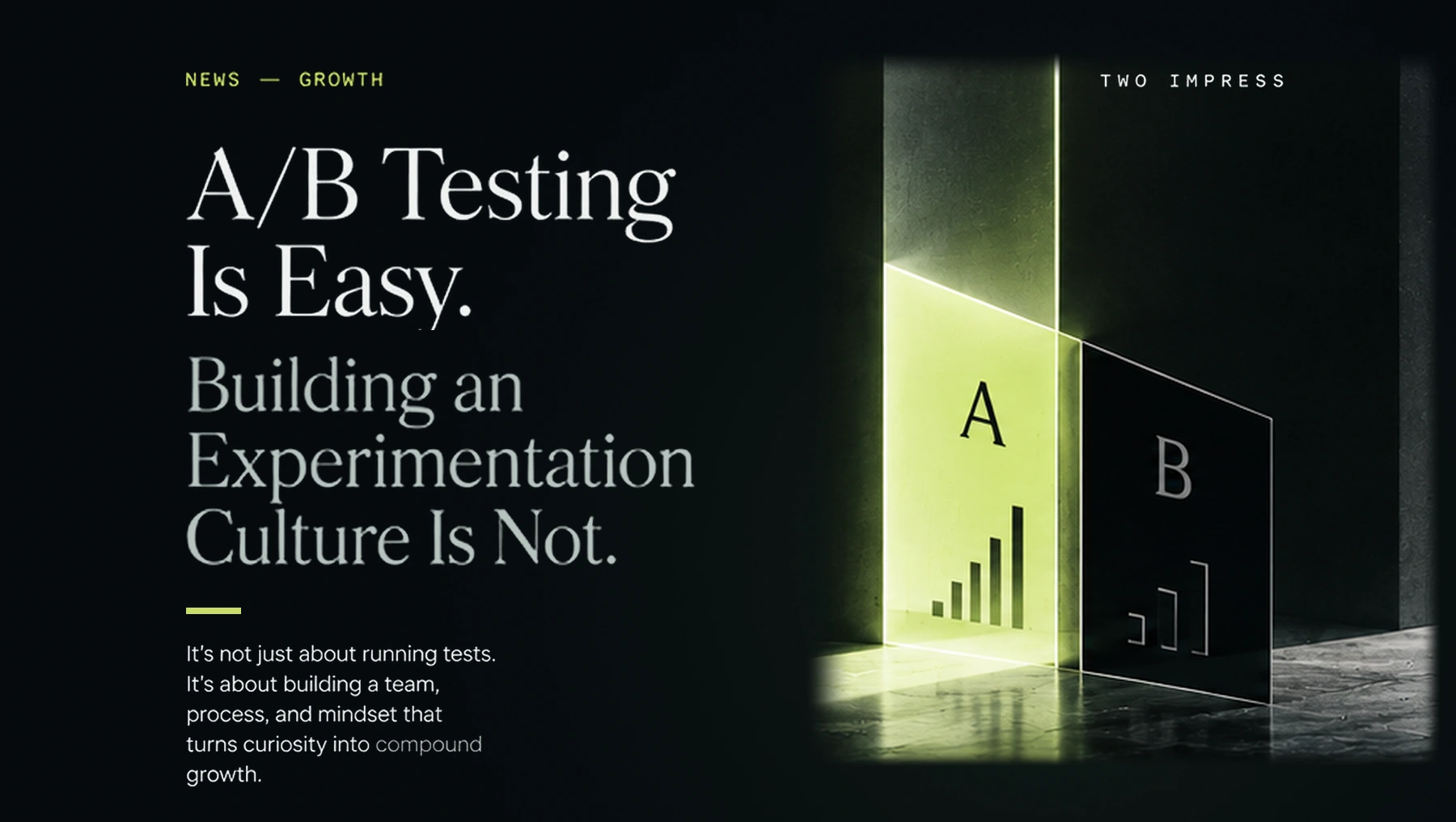
Most agencies will tell you they can run A/B tests.
Some of them are very good at it.
But running experiments and building the ability to experiment well over time are two very different things—and if you don’t understand the difference, you’ll feel it six months after launch.
At Two Impress, we’ve seen this play out again and again. Teams invest in optimization tooling, launch a few tests, get mixed results, and slowly lose momentum. Not because the tool didn’t work—but because experimentation was treated as a service, not a capability.
This post is about that gap.
When companies come to us asking about A/B testing, personalization, or optimization, they’re usually standing at a fork in the road—even if they don’t realize it yet.
This is the most common approach.
You hire an agency.
They design hypotheses.
They build variants.
They run the tests.
They send reports.
It’s fast.
It’s efficient.
And for many teams, it’s the right place to start.
But it has a ceiling.
When optimization lives entirely outside your organization, your internal team doesn’t develop the muscle memory required to:
When the engagement ends, experimentation often ends with it.
Enablement is slower at first—but more durable.
Instead of acting as a black box, the agency works with your team:
The goal isn’t dependency.
The goal is capability.
This path requires more patience, more transparency, and more trust—but it’s how experimentation becomes part of how your organization thinks, not just what it occasionally buys.
Here’s the honest truth most agencies won’t say out loud:
Execution-first agencies often struggle with enablement because:
Enablement-only partners, on the other hand, may leave teams overwhelmed without hands-on support when things get real.
So most agencies pick a lane.
We didn’t.
At Two Impress, we believe clients shouldn’t have to choose between:
We intentionally designed our optimization services to support both execution and enablement, because enterprise teams are not static. They evolve.
Some teams want:
Others want:
Most want:
So that’s how we work.
Enablement is not a workshop.
It’s not documentation.
It’s not a one-time training.
In real engagements, enablement looks like:
The end goal isn’t to make ourselves indispensable.
The end goal is to make experimentation sustainable.
None of this diminishes the importance of execution.
Strong experimentation still requires:
We do all of that.
But we don’t believe execution and enablement are mutually exclusive. In fact, we believe the strongest optimization programs require both.
Tools like Webflow Optimize lower the barrier to experimentation—but they don’t remove the responsibility.
The tool can:
What it cannot do is:
That’s where enablement changes outcomes.
Here’s the question we encourage every client to ask themselves:
Do we want optimization done for us, or do we want optimization to become something we own?
There’s no wrong answer.
What matters is that you know the difference—and that you don’t have to change agencies when your answer changes.
Two Impress isn’t just an A/B testing agency.
We’re not just an enablement partner either.
We’re built for organizations that want:
Whether you need someone to run experiments for you, help you learn how to run them yourself, or guide you through both—we believe you should be able to choose without starting over somewhere else.
That’s the difference.
SERVICE EXAMPLES